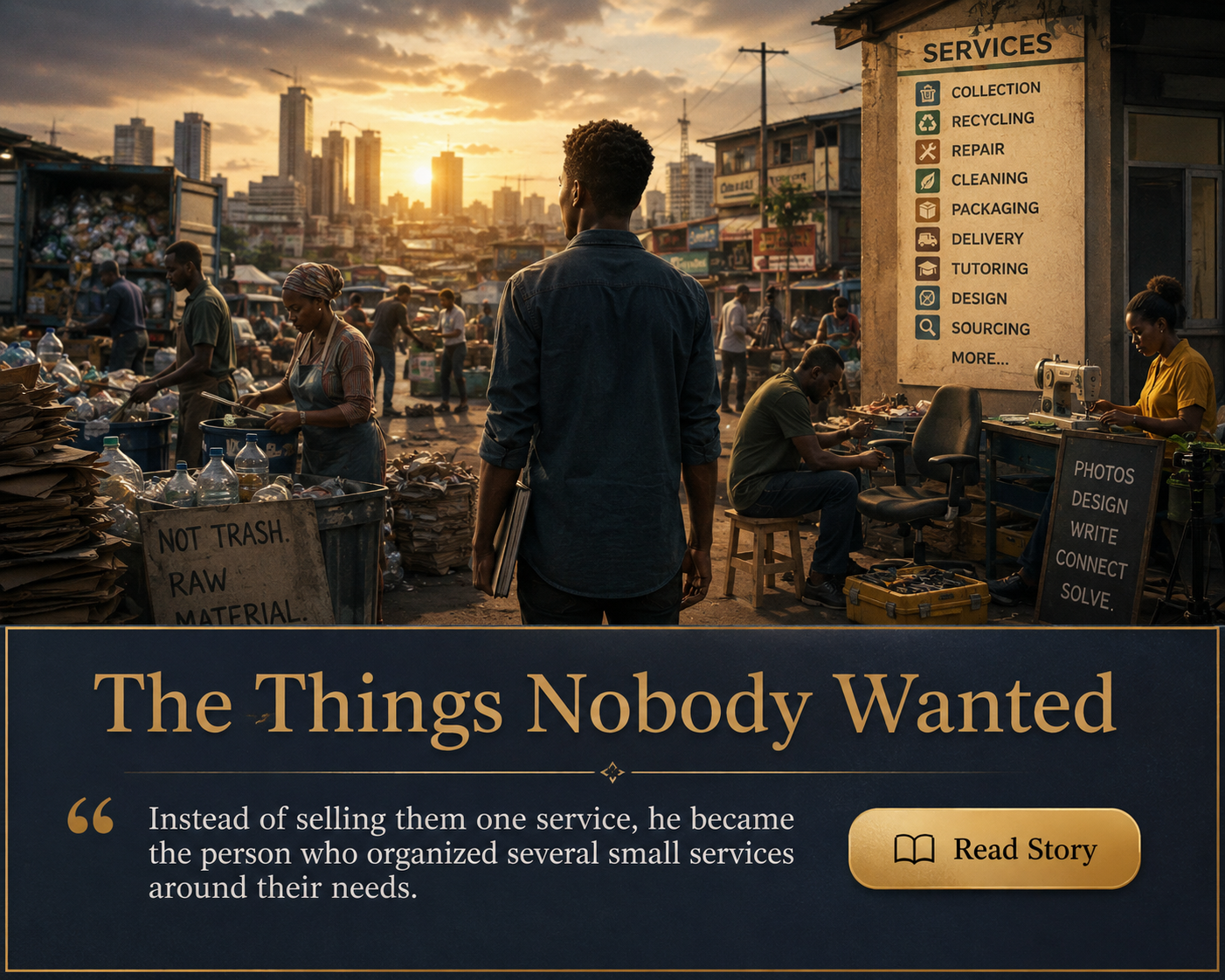
The Things Nobody Wanted
The first time Daniel made ₦180,000 in one afternoon, he was standing beside a mountain of rubbish while his former classmates were posting pictures from a rooftop restaurant.
He took a photograph of the money on his phone, then immediately deleted it.
Not because he was ashamed of the money.
He was ashamed of how he had earned it.
Three years earlier, Daniel had been the kind of young man who believed a respectable income had to come from a respectable-looking job. He worked as an administrative assistant at a construction company, wore a tucked-in shirt every morning and spent eight hours pretending that moving documents from one desk to another was a meaningful contribution to civilization.
Then the company reduced salaries.
Daniel survived the cut, but his confidence did not.
He began looking for something else to do after work. His first attempt was selling imported phone accessories online. He bought a small batch, paid for advertisements and waited.
The products barely moved.
His second idea was frozen food.
That failed faster.
His third idea was a clothing business, which ended when he discovered that having beautiful clothes in your house was not the same thing as having customers who wanted to buy them.
One Saturday, frustrated and broke, Daniel followed his friend Musa to a small workshop behind a market.
Musa was there to repair an industrial machine. Daniel noticed something strange. The mechanic had three customers waiting, but the mechanic wasn’t the one making the most money.
An elderly woman sitting outside was collecting the workshop’s discarded metal pieces.
“What is she doing?” Daniel whispered.
“Buying the scrap,” Musa said.
“Buying rubbish?”
The mechanic laughed. “You young people think everything is rubbish.”
The woman was called Mama Ijeoma. She had been buying metal scraps from mechanics, construction sites and fabricators for years. She sorted them according to type and sold them to larger dealers.
Daniel expected the business to be tiny.
Then Mama Ijeoma showed him her notebook.
That month, she had made more money from collecting discarded metal than Daniel had earned from his office job.
Daniel went home thinking about it.
The following week, he began noticing things differently.
A furniture maker was throwing away mountains of sawdust. A restaurant was paying someone to remove used cooking oil. A supermarket was paying to dispose of damaged cartons. A young woman nearby was making attractive food packages for small restaurants because most of them couldn’t afford professional packaging companies. A man repaired broken office chairs and sold them to newly opened businesses. Another person rented out ladders, drilling machines and other equipment that people needed only occasionally.
None of them looked wealthy.
But they were all solving problems.
Daniel started keeping a notebook.
He wrote down every ordinary thing people complained about paying for.
Within months, his notebook became more valuable than his failed business ideas.
He began with waste collection. Instead of simply collecting rubbish, he connected people who had unwanted materials with people who needed them.
He connected a bakery’s cardboard waste to a packaging dealer.
He connected a furniture workshop’s sawdust to a buyer who used it for another purpose.
He helped restaurants find someone to collect their used cooking oil.
He connected small food businesses with affordable packaging suppliers.
Then he noticed something even more interesting.
Many of these small operators were terrible at selling themselves.
They had skills but no customers.
So Daniel began helping them advertise.
He created simple flyers, took photographs of their products and posted them online. He charged small fees at first.
Soon he had three sources of income.
Then five.
Then seven.
Waste recovery. Sourcing. Digital marketing. Packaging connections. Equipment rentals. Delivery coordination. Small-business promotion.
His friends thought he was confused.
“You are doing too many things,” one told him.
Daniel laughed. “Maybe. But they all have customers.”
The business finally changed when a hotel approached him with a problem.
They were spending too much money disposing of waste, buying packaging and finding temporary workers for maintenance jobs.
Daniel offered to coordinate everything.
Instead of selling them one service, he became the person who organized several small services around their needs.
That was the moment he understood what he had been building.
He wasn’t a rubbish collector.
He wasn’t a marketer.
He wasn’t a middleman.
He was building a network of overlooked skills.
People who were good at things but had never learned how to turn those things into reliable income could plug into his network. Customers who needed small jobs done could find them through him.
Daniel took a percentage for making the connection and managing the service.
The business grew slowly.
There were bad months. Customers delayed payment. Workers disappeared halfway through jobs. One supplier cheated him. A truck broke down on the worst possible Monday. Daniel nearly quit twice.
But every problem taught him something.
Eventually, the company had a small warehouse, a few employees and dozens of independent workers.
Then came the family gathering that changed everything.
His uncle, who had spent years teasing him about his “rubbish business,” asked what he was doing these days.
Daniel hesitated.
Before he could answer, his younger cousin shouted, “He does everything!”
Everyone laughed.
Daniel laughed too.
Then his phone rang.
It was a hotel asking for a new service contract.
Another call came five minutes later from a manufacturer.
Then a restaurant.
Then a furniture company.
Daniel looked around the table while his phone kept vibrating.
His uncle stared at him.
“So all these people are paying you?”
Daniel nodded.
His uncle leaned back slowly.
“But what exactly do you do?”
Daniel smiled.
“I find things people overlook and make them useful.”
For once, nobody laughed.
Daniel never became wealthy because he discovered one magical side hustle.
He became wealthy because he stopped asking whether a job looked impressive and started asking a much more useful question:
Does someone have a problem that I can solve?
The answer was usually yes.
Lesson
There are income opportunities hiding inside ordinary problems, unpopular jobs and skills people overlook. You do not always need one brilliant business idea; sometimes the bigger opportunity is learning several useful skills, connecting people who need them, and becoming valuable enough that money follows the usefulness. The work may look small from the outside, but a person who learns how to organize small opportunities can eventually build something much bigger than any single opportunity.
One response to “Examples of income streams”
There are income opportunities hiding inside ordinary problems, unpopular jobs and skills people overlook.