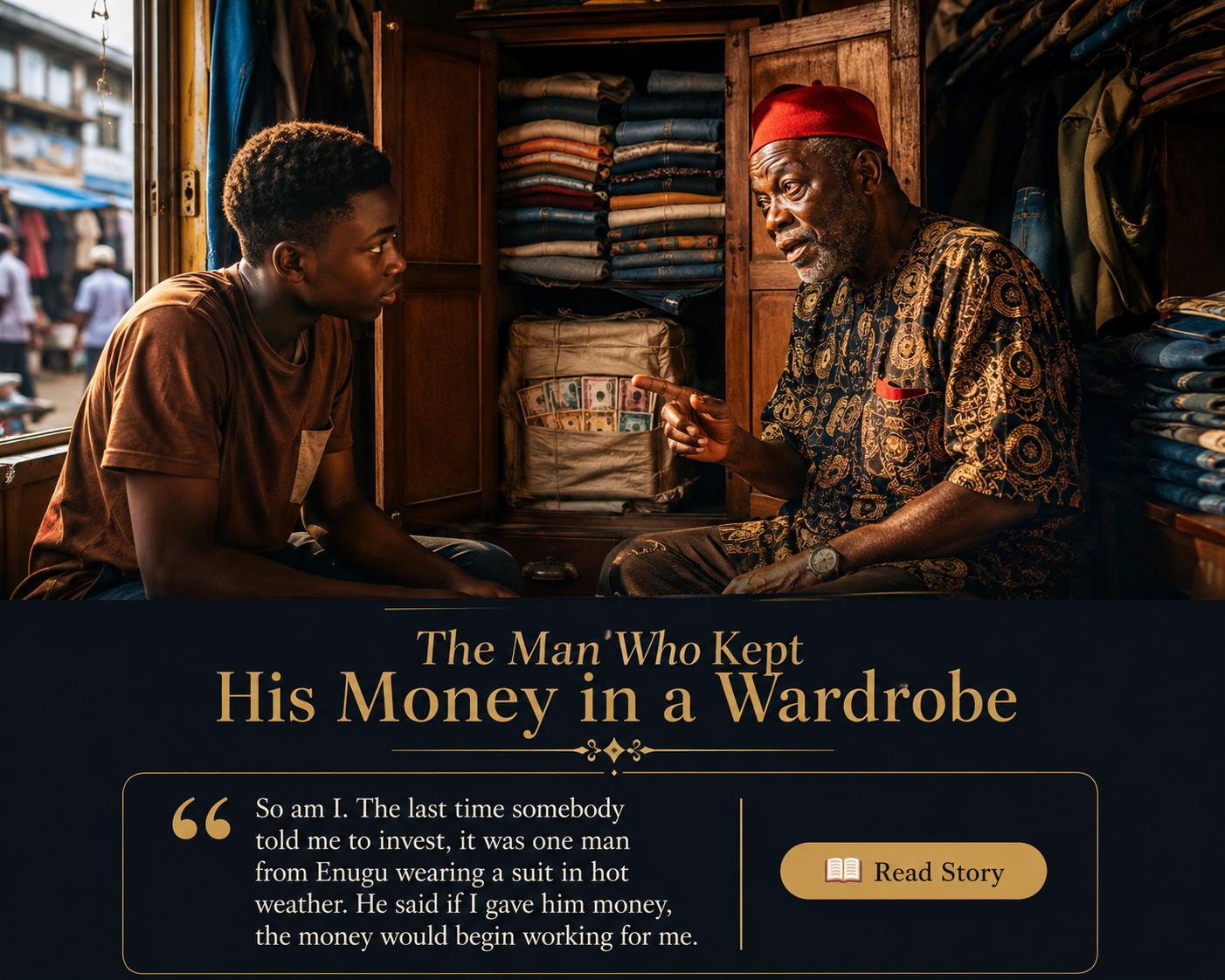
The Man Who Kept His Money in a Wardrobe
Ebeano, was fifty-nine years old man, and has a clothing shop inside onitsha main-market.
He owned three large wardrobes, and trusted none of them equally.
The first contained clothes he wore. The second contained clothes he hoped to wear again when his stomach finally agreed to cooperate. The third, which stood in a small room behind his house in Onitsha, contained his money.
Not all of it, of course. Ebeano was not a fool.
Some of his money was in the bank. Some was rotating around town in the hands of people who had promised to pay him “next week.” And some—what he called his emergency emergency money—was hidden inside a faded wrapper tucked beneath a pile of trousers nobody had bought in eleven years.
His grandson, seventeen-year-old Somto, discovered this by accident.
“Grandpa,” he said one Saturday, holding up the wrapper, “why is this trouser crying?”
Ebeano snatched it from him. “What kind of question is that?”
“Because it is full of money.”
“That is not your concern.”
Somto looked at the thick bundle of notes. “Grandpa, how long has this been there?”
Ebeano frowned. “Long enough to know that it has not stolen itself.”
“But you could invest it.”
Ebeano stared at him.
Then he laughed.
It began as a small laugh, the kind he gave when customers asked for a discount after already buying three shirts on credit. But it grew until he had to remove his glasses.
“Invest it?” he repeated. “You children have started again.”
“Grandpa, I’m serious.”
“So am I. The last time somebody told me to invest, it was one man from Enugu wearing a suit in hot weather. He said if I gave him money, the money would begin working for me.”
Somto nodded.
“I asked him if my money had legs.”
Somto covered his face.
Ebeano continued proudly. “I told him, ‘My money has been sitting down since I was born. Now you want to send it to work without me?’”
“Grandpa!”
“What?”
Somto pulled out a plastic chair and sat beside him. “That is not exactly what investing means.”
Ebeano adjusted his glasses. “Then explain it. But if you mention cryptocurrency, I will chase you out.”
“I wasn’t going to.”
“Good. Because the last time I heard that word, a man in my market lost money and began speaking in proverbs for three months.”
Somto laughed, but Ebeano was serious. He had seen too many people in the market lose money to schemes with big English names and small addresses. He preferred things he could touch: bales of clothes, cartons, bundles of fabric. If his money became something he could not hold, how would he know it still existed?
That afternoon, they sat in the shop while Ebeano arranged jeans on a shelf and Somto tried to explain investing without sounding like one of the people Ebeano disliked.
“Grandpa,” Somto said, “you already invest.”
Ebeano stopped folding a shirt.
“I do?”
“Yes.”
“When?”
“Every time you buy clothes to sell.”
Ebeano narrowed his eyes. “That is business.”
“Exactly. You put money into something because you believe it will grow into more money.”
Ebeano slowly put down the shirt.
Somto continued. “You bought that bale of jackets last month.”
“Yes.”
“You paid for it, took a risk that people would buy, and now you’re making a profit.”
“That is because I understand clothes.”
“So investing is not necessarily about understanding everything. It is about understanding what you are putting your money into.”
Ebeano looked unconvinced.
“But,” Somto added, “with your business, you are doing most of the work yourself. Investing can also mean putting money into something you own partly, while other people manage the daily work.”
Ebeano stared at him. “So I can own something without opening shop there every morning?”
“Yes.”
“Hmm.”
For the next two weeks, Ebeano became suspiciously interested in Somto’s explanations. He asked questions while driving, eating, watching football and even in the bathroom.
“Somto!”
“Yes, Grandpa?”
“If a company makes profit, do they come and share my portion at my house?”
“Sometimes profits may be paid out to shareholders.”
“Ah. So they know my house?”
“No.”
“Then how will they find me?”
Somto sighed.
They started slowly. Somto showed him the difference between saving and investing. Savings, he explained, was useful for money Ebeano might need soon. Investing was generally for money he could leave alone for longer periods, understanding that its value could rise and fall.
Ebeano liked the part about “rise.”
He disliked the part about “fall.”
“Nothing I own should be falling,” he said. “Not my money. Not my trousers. Not my customers.”
“Grandpa, that is why people need to understand risk.”
Ebeano did not like risk either.
He had spent years building his clothing business one customer at a time. He knew which traders paid late, which customers returned fake receipts, and which relatives appeared only when there was a new car in the compound. He did not become fifty-nine by giving money to strangers because they drew graphs on a screen.
So Somto did not push him.
Instead, he helped Ebeano learn. They talked about different types of investments, why spreading money could reduce the danger of depending on one thing, and why promises of guaranteed huge returns should make a person suspicious enough to hold their wallet with both hands.
Then something happened.
Ebeano’s younger brother called from Lagos.
“I have found an opportunity,” the man announced.
Ebeano sat up.
“What opportunity?”
“A platform.”
Ebeano’s eyes moved toward Somto, who had suddenly become very interested in the television.
The brother continued excitedly. “Everybody is joining. You put in money and they trade international things. My friend has already doubled his money.”
“How?”
“He said the system is automated.”
Ebeano asked for details. The answers became foggy. The company had no clear office. The explanation changed every time he asked a question. The promised return sounded so large that even Ebeano, who still kept money in a wardrobe, became uncomfortable.
After the call, he sat quietly.
Somto waited.
Finally, Ebeano said, “Your uncle says his money is working for him.”
Somto nodded carefully.
Ebeano looked toward the old wardrobe.
“My money has been sitting down for years. Yet I suddenly feel safer.”
Somto burst out laughing.
But Ebeano did not invest in the platform. Instead, he began doing something that surprised his family. Before putting money into anything, he asked questions. What exactly am I buying? Who manages it? How does it make money? What can I lose? How quickly can I access my money if I need it?
His sons complained that Somto had turned their father into an interviewer.
One evening, Ebeano took his grandson to the small room behind the house. He opened the third wardrobe.
“Grandpa,” Somto said, “please don’t tell me you have another bundle.”
Ebeano smiled.
“I do.”
He removed the faded wrapper and handed it to Somto.
“I have kept this money here for almost nine years.”
Somto looked shocked.
Ebeano continued. “I thought keeping money meant protecting it. But I am beginning to understand something. Money can be safe and still not be doing anything useful.”
Somto said nothing.
Ebeano looked at the bundle one last time.
Then he carried it to the front room.
He did not put all of it into an investment. Some went into proper savings. Some remained available for emergencies. And some, after weeks of research and questions that nearly exhausted everyone around him, went into carefully chosen investments he understood well enough to explain in his own words.
Months later, Ebeano still sold clothes at Onitsha Main Market. He still negotiated like a man defending national territory. He still hid small amounts of cash in strange places.
But whenever Somto visited, Ebeano would point at him proudly and tell customers, “This boy taught me how to make my money work.”
Somto would smile.
Then Ebeano would add, “But I am still supervising it.”
Lesson
Investing is not magic, and it is not a game of giving your money to the person with the loudest promise. The first investment may not be the money you put somewhere—it may be the time you spend understanding where your money is going. You do not need to know everything before you begin, but you should know enough to avoid handing your future to something you cannot explain. Even Ebeano learned that money does not need legs to work, but it definitely needs a wise owner to decide where it should go.
One response to “What is investing?”
An investment can either rise or fall. It is a calculated risk