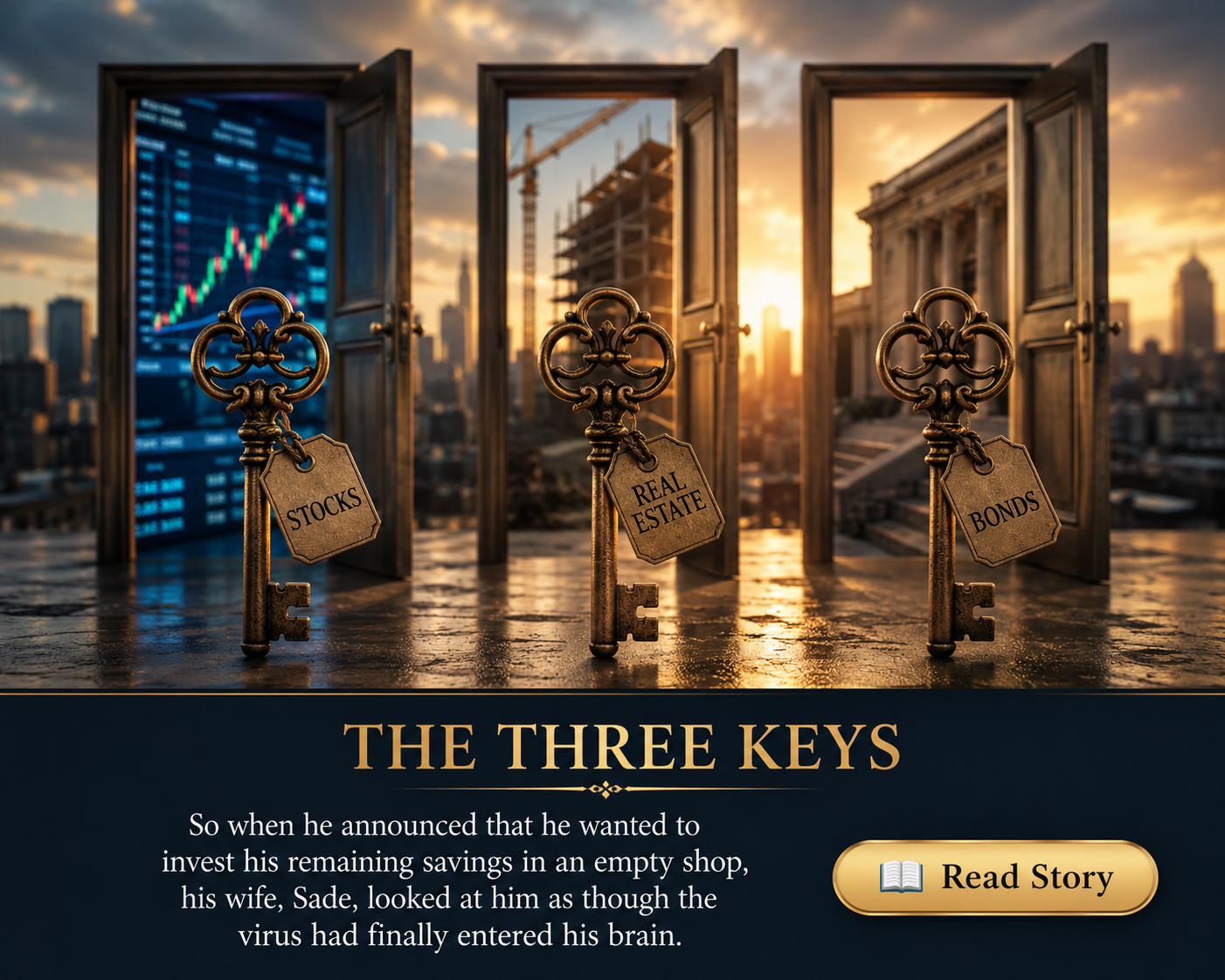
The Three Keys
Ebuka nearly dropped his phone into the soup when Chike shouted, “I have found it!”
Eze looked up from the restaurant table. “If it is another online course on how to become a billionaire before Christmas, please keep your discovery to yourself.”
“It is not a course,” Chike said, sliding into the seat beside them. “It is the answer to our problem.”
Ebuka frowned. “What problem?”
“Our problem of being poor.”
“We are not poor,” Eze said.
Chike looked at the three of them: three young men in their late twenties, all wearing office shirts that had been ironed early that morning and confidence that had been damaged by the end of the month. “You checked your account balance before ordering this food.”
“That is not poverty,” Ebuka said. “That is financial awareness.”
“You transferred money from your savings to buy pepper soup.”
“Emergency.”
Chike smiled. “Exactly.”
The three friends had started work around the same time. Ebuka was a software support officer, Eze worked in a bank, and Chike had recently become a sales executive for a pharmaceutical company. Every month, they complained about the same things: transport, rent, family requests, unexpected expenses and the mysterious way salary disappeared within days of arriving.
Then, one evening, Chike announced a challenge.
“We each have the same savings,” he said. “Let us invest them differently for three years and see who does best.”
Eze leaned forward. “That actually sounds interesting.”
Ebuka pointed his spoon at Chike. “What is the prize?”
“The winner buys suya.”
“With his profit?”
“With the losers’ money.”
That was how three young men, who had spent years arguing about football, relationships and which restaurant served the most suspicious-looking chicken, began arguing about wealth.
Ebuka chose stocks.
“I like growth,” he said. “I want my money working in companies.”
Chike chose real estate, although his version of real estate was not buying a building. He joined a carefully researched property investment opportunity and began contributing toward a small piece of a development.
Eze chose bonds.
Chike stared at him. “Bonds?”
“Yes.”
“Bonds?”
“Yes.”
Ebuka shook his head. “Eze, even the name sounds like something your grandfather would buy.”
Eze calmly opened his laptop. “I work in a bank. I like things that do not make my heart beat unnecessarily.”
For the first few months, nothing dramatic happened.
Then Ebuka’s stocks began rising.
He became unbearable.
Whenever they met, he would casually mention percentages.
“My portfolio went up today.”
“Who asked?” Chike would say.
“I am just sharing good news.”
“You share it like a man announcing the birth of a son.”
Ebuka began walking differently. Not rich differently. Just financially optimistic differently. He started speaking about “the market” as though he owned a section of it.
Then one morning, the market fell.
Ebuka came to work looking like someone had cancelled his wedding.
Chike called him.
“How are the stocks?”
Silence.
“Ebuka?”
“They are resting.”
“Resting?”
“Yes.”
“How much?”
“They are correcting.”
Eze laughed so hard that a colleague turned to look at him.
But Ebuka refused to sell. He had chosen his companies after research, and he had promised himself he would not treat every bad day like a national emergency.
Meanwhile, Chike’s real estate investment moved at the speed of a tortoise carrying groceries. Construction updates arrived monthly: foundation completed, walls rising, roofing stage.
“That is all?” Ebuka asked after six months.
“Yes.”
“My stocks can move in one afternoon.”
“And fall before dinner.”
Then Eze would receive his bond interest.
Nothing dramatic. Nothing exciting. Just money arriving exactly when expected.
Ebuka called it boring.
Chike called it old-man wealth.
Eze smiled. “Boring things are underrated. Oxygen is boring too.”
A year passed. Ebuka’s stocks recovered and grew. Chike’s property project progressed. Eze’s bonds continued doing exactly what they had promised to do.
Then Chike lost his job.
The company restructured. His position disappeared. One Monday he was planning sales targets; by Friday he was carrying his belongings out in a carton.
At first, he laughed about it.
“More time for entrepreneurship,” he said.
But two months later, the jokes disappeared. His real estate investment was still tied to the project. His money had not vanished, but neither could he easily turn bricks, walls and future apartments into rent money.
One evening, the three friends sat quietly outside Ebuka’s apartment.
Chike stared at the road. “I thought an investment was just money that grows.”
Eze looked at him. “Sometimes it grows, but you cannot eat it immediately.”
Ebuka nodded.
Chike laughed bitterly. “Wonderful. My money is becoming an apartment while I am becoming a tenant.”
Nobody laughed.
The next day, Eze transferred him some money.
“A loan?” Chike asked.
“No. I have cash savings outside my investments.”
Chike looked at him.
Eze shrugged. “Even old men know something.”
That moment changed the competition.
They stopped asking which investment was best and started asking different questions.
What did each investment do well? How quickly could they access the money? How much risk could they handle? What happened when life refused to follow the plan?
Ebuka admitted that watching his stocks fall had taught him that growth came with emotional turbulence. Chike learned that real estate could build wealth slowly, but slow wealth was not the same as accessible money. Eze admitted that his bonds gave him stability, but stability alone might not carry him toward every goal he had.
Three years later, they met again at the same restaurant.
Ebuka arrived first, looking healthier and less interested in telling people his portfolio performance. Chike had found a new job and his property investment had finally appreciated. Eze was still Eze, except now even Chike had stopped calling his investments boring.
They placed their phones on the table and compared results.
Ebuka had the highest return.
Chike was close behind.
Eze had the lowest.
Chike sighed. “So Ebuka wins.”
Ebuka smiled.
Eze said, “Technically.”
Ebuka frowned. “What does that mean?”
Eze turned his phone toward them. “During those three years, I also slept peacefully, had predictable returns and had money available when Chike needed help.”
Chike nodded. “True.”
Ebuka leaned back. “Fine. Then who really won?”
Chike looked at the waiter. “The restaurant. We have been coming here for three years.”
They burst out laughing.
Then Ebuka raised his glass. “Maybe the point was never to find the best investment.”
Eze nodded.
“Maybe,” Chike said, “the point is to understand what your money is doing before you hand it over.”
This time, nobody argued.
Lesson
There is no single investment that wins every race. Stocks may offer stronger growth but can test your patience, real estate may build value while demanding time and commitment, and bonds may provide steadier returns without the same excitement. The smartest choice is not always the investment with the biggest number—it is the one that fits your goals, your timeline and the kind of surprises life might throw at you. Sometimes wealth is not choosing one door and declaring the others useless. Sometimes it is knowing why each door has a different key.
One response to “Stocks, bonds, real estate”
The smartest choice is not always the investment with the biggest number—it is the one that fits your goals, your timeline and the kind of surprises life might throw at you.