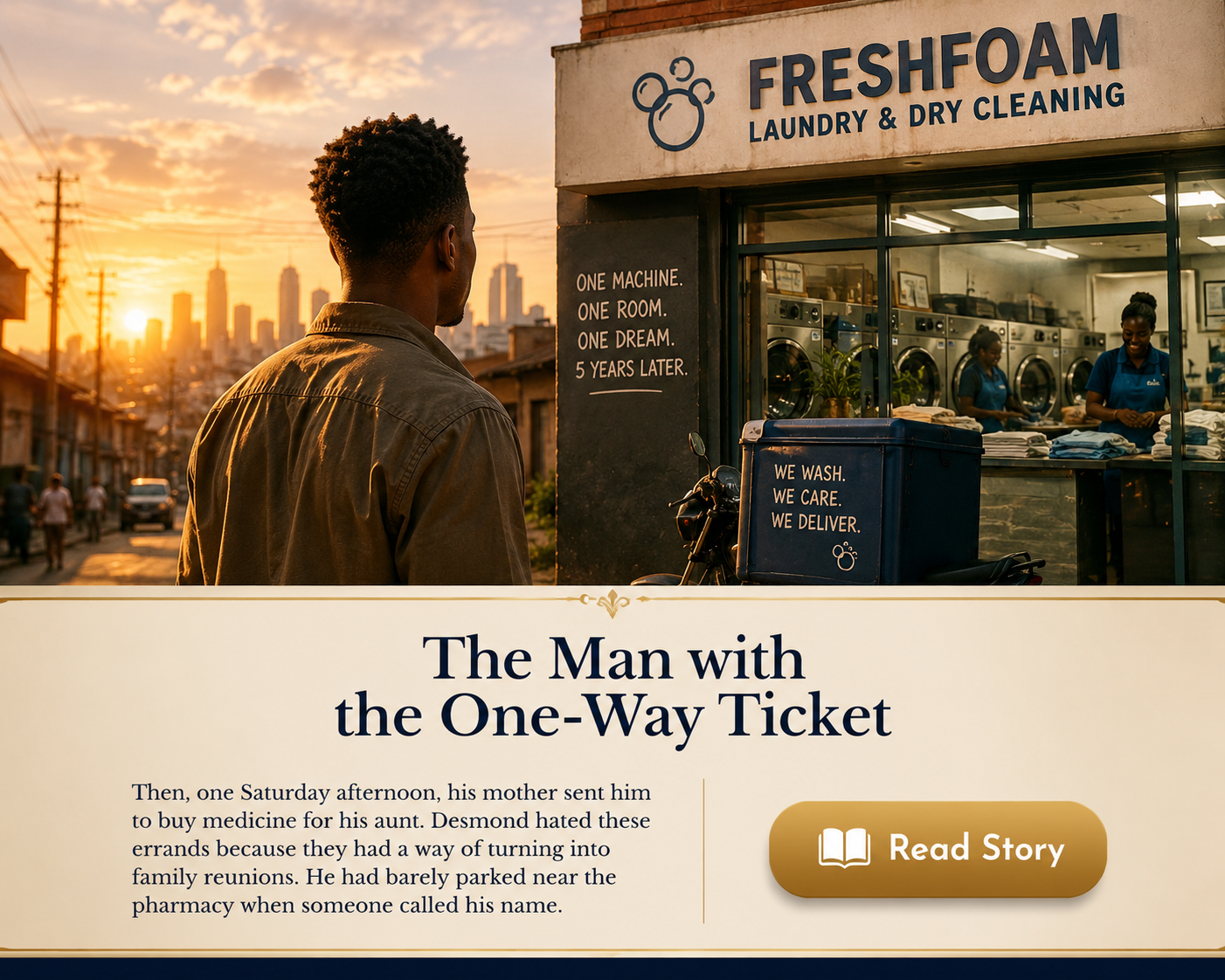
The Man with the One-Way Ticket
Desmond believed small money had a strange talent for disappearing. Give him ₦10,000, and before the weekend it would have become data, shawarma, transport, two unnecessary online purchases and a mysterious bank charge called “service fee,” which he was convinced existed solely to insult poor people. So whenever anyone told him he could start investing with little money, he laughed as though they had suggested he build an airport with toothpicks. “Invest what?” he would ask. “My transport money? My future children’s school fees? The money is already small. Must I now divide it into smaller pieces and watch it grow old?”
At twenty-nine, Desmond worked as a customer service officer in a telecommunications company and had become something of an expert in postponing his financial future. He was not irresponsible. That was the thing. He paid his bills. He occasionally saved money. He even had a spreadsheet on his laptop called “2026 Financial Goals,” which he opened every three months, stared at for seven minutes, and closed with the deep emotional exhaustion of a man who had reviewed the national budget. His real problem was that he believed progress had to begin with an impressive amount of money. Until he had enough to do something “serious,” he preferred to wait.
“Just start with something,” his friend Ifeoma told him one evening as they sat outside a suya spot.
Desmond looked at her. “With what?”
“Whatever you can afford.”
“That is how people enter problems.”
“That is how people enter investments.”
“Same thing sometimes.”
Ifeoma laughed, but Desmond was serious. In his mind, investing ₦5,000 or ₦10,000 at a time was like trying to fill a swimming pool with a teaspoon. He wanted a big starting point, the kind that made people sit up when you mentioned the amount. He wanted the dramatic beginning. Not the embarrassing little beginning that could disappear into the background of his account without making history.
Then, one Saturday afternoon, his mother sent him to buy medicine for his aunt. Desmond hated these errands because they had a way of turning into family reunions. He had barely parked near the pharmacy when someone called his name.
“Desmond!”
He turned and saw a broad man in a blue polo shirt standing beside a building with a bright sign above the entrance.
FRESHFOAM LAUNDRY & DRY CLEANING.
Desmond stared for a few seconds before recognition arrived.
“Mr. Chuka?”
The man laughed. “Now you remember me.”
Desmond remembered him very well. Five years earlier, Mr. Chuka had lived two buildings away from his former apartment. Back then, the man had owned one used washing machine that shook so violently during spin cycles that neighbours often came outside to confirm whether a small earthquake had occurred. Every morning, Mr. Chuka would walk from compound to compound carrying flyers and a large bag.
“Laundry, sir! Laundry, madam! Wash, iron, fold!”
Desmond remembered seeing him return with clothes piled so high that his one-room apartment looked like a confused clothing market. Sometimes he washed clothes until midnight. Sometimes the washing machine broke down and he washed by hand. Desmond had always assumed the business would eventually collapse, mostly because Mr. Chuka seemed to own more extension cables than assets.
But now, the small building before him had industrial washing machines visible through the glass. Two young women in uniforms were sorting clothes. A delivery rider was loading neatly packed items into a branded motorcycle box.
Desmond looked around. “You work here?”
Mr. Chuka slapped his shoulder. “I own here.”
Desmond blinked. “This place?”
“And another branch in Wuse.”
Desmond looked at him again, this time with the suspicious expression of a man who had just discovered that his former neighbour might secretly be a billionaire.
Mr. Chuka noticed. “Don’t worry. I have not become Dangote.”
“Ah. Because I was about to ask for a loan.”
They both laughed, and Mr. Chuka invited him inside. The place smelled of detergent, steam and expensive electricity. Desmond listened as Mr. Chuka explained how the business had grown. The first washing machine had been second-hand because it was all he could afford. The first customers had come from knocking on doors. The first profit had not gone into a new phone or a celebration. It had gone into repairs, supplies and another machine. When the business became slightly more stable, he saved again. Then he bought a dryer. Later, he rented a proper shop. He hired one assistant. Then another.
“It was not fast,” Mr. Chuka said.
Desmond looked through the glass at one of the machines turning steadily.
“I know,” he replied. “Five years.”
Mr. Chuka nodded. “Five years can pass whether you start or not.”
The sentence followed Desmond home.
That evening, he opened his banking app and looked at his savings. He was not suddenly inspired by dramatic music. No voice from heaven spoke. Nobody sent him a message saying he was destined for wealth. He simply remembered the old washing machine shaking in that tiny apartment.
Desmond had spent years waiting to have enough money to begin something meaningful. Mr. Chuka had begun with an amount so small that the business had started in a room where the washing machine competed for space with his bed.
Desmond finally understood what had bothered him about small investments. He wanted the beginning to look like the ending.
The following week, he set aside a small amount of money and began investing it regularly. It was not enough to impress anybody, so naturally, he told almost nobody. Some months he invested more. Some months he could only manage a little. He learned before putting his money anywhere, asked questions, and avoided anything that promised to turn his money into a private jet by Christmas. His friends occasionally teased him.
“So how much have you made now?” one of them asked after a few months.
Desmond smiled. “Enough to buy one tyre.”
They laughed.
But he continued.
Months later, when he checked what had gradually accumulated, he felt something he had not expected: respect for his younger self. Not because he had become rich. He had not. Not because his money had suddenly transformed his life. It had not. But because he had finally stopped treating a small beginning as an insult.
One afternoon, Desmond passed Mr. Chuka’s first location and saw a young man standing outside with a small flyer. The man was advertising laundry pickup services.
Desmond smiled.
“Good luck!” he called.
The young man looked up. “Thank you, sir!”
Desmond continued walking, thinking about old washing machines, tiny investments and the strange human habit of refusing to plant a seed because it did not already look like a forest.
Lesson
Small money may not change your life overnight, but neither does small effort, small business or small progress. The mistake is not always starting small; sometimes, it is spending years waiting for a “big enough” beginning that never arrives. Desmond learned that growth rarely announces itself with fireworks. Sometimes it begins quietly, with an amount too small to impress anyone, and keeps growing while the people who laughed are still waiting to have enough to start.
One response to “Investing with little money”
The mistake is not always starting small; sometimes, it is spending years waiting for a “big enough” beginning that may never arrives.